From Octopus Paul to Artificial Intelligence: A New Era of World Cup Predictions
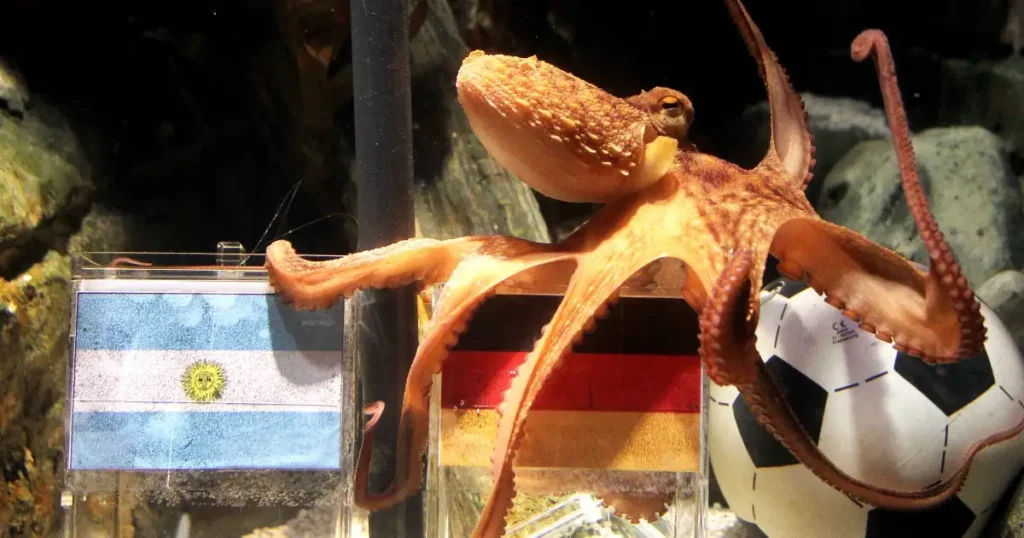
The way FIFA World Cup outcomes are predicted has changed dramatically over the past two decades. What was once based on the choices of a famous octopus is now driven by artificial intelligence, machine learning, and advanced data analytics to identify potential tournament winners.
When Octopus Paul Became the World’s Most Famous Predictor
Before the rise of AI and data-driven forecasting models, the football world was captivated by Paul the Octopus. During UEFA Euro 2008 and the 2010 FIFA World Cup, Paul gained global attention for his surprisingly accurate predictions.
Born in Weymouth, England, and later housed in Germany, Paul correctly predicted 11 of Germany’s 13 matches across the two tournaments. His forecasting method was simple but fascinating. He chose between two containers marked with the flags of competing nations, and the selected container was considered the predicted winner.
What began as a small aquarium attraction quickly became a worldwide sensation. Media outlets, football fans, and even political figures followed his predictions closely. During the 2010 World Cup, Paul became one of the most talked-about personalities in the sporting world.
Although he passed away in 2010, his legacy remains one of the most memorable chapters in the history of sports forecasting.
AI Takes Over the Prediction Game
By 2026, the world of World Cup forecasting has undergone a complete transformation. Artificial intelligence and data-driven models have largely replaced traditional and novelty-based prediction methods.
Modern AI systems evaluate a wide range of factors, including player performance, team rankings, recent form, tactical patterns, historical records, and squad valuations. These models then simulate tournament scenarios thousands of times to estimate the probability of different teams winning the title.
As a result, countries such as Spain, France, Argentina, and England frequently emerge as leading contenders in AI-generated predictions.
Why Do AI Models Produce Different Forecasts?
Despite their sophistication, AI models do not always reach the same conclusions.
Each system relies on different datasets, algorithms, and priorities. Some models place greater emphasis on recent performances, while others focus on squad depth, coaching quality, market value, or historical achievements.
This is why one model may identify France as the favorite, while another ranks Spain or Argentina at the top. Some simulations have even highlighted Norway as a potential dark-horse candidate capable of exceeding expectations.
Unlike Paul’s straightforward selections, AI forecasts are built on complex calculations and extensive data analysis.
Humans vs AI: The Next Prediction Battle
As AI continues to reshape sports forecasting, prediction contests are evolving as well.
Technology companies around the world are developing platforms where AI systems and football fans can compete directly against each other in predicting match outcomes. Supporters will be able to compare their football knowledge with machine-generated forecasts.
These initiatives not only demonstrate the growing capabilities of artificial intelligence but also create a more interactive and engaging experience for fans during major tournaments.
Football’s Greatest Strength: Unpredictability
The journey from Octopus Paul to modern AI models highlights the remarkable progress made in sports analytics and forecasting technology. Today’s systems can analyze millions of data points and evaluate thousands of possible scenarios.
Yet one element remains beyond the complete control of technology: football itself.
Unexpected upsets, moments of individual brilliance, tactical masterstrokes, and high-pressure situations often overturn even the most carefully calculated predictions. Whether the forecast comes from an octopus or a cutting-edge AI model, the World Cup consistently proves that uncertainty is one of the sport’s defining characteristics.
And that unpredictability is precisely what makes the FIFA World Cup one of the most exciting and beloved sporting events in the world.