


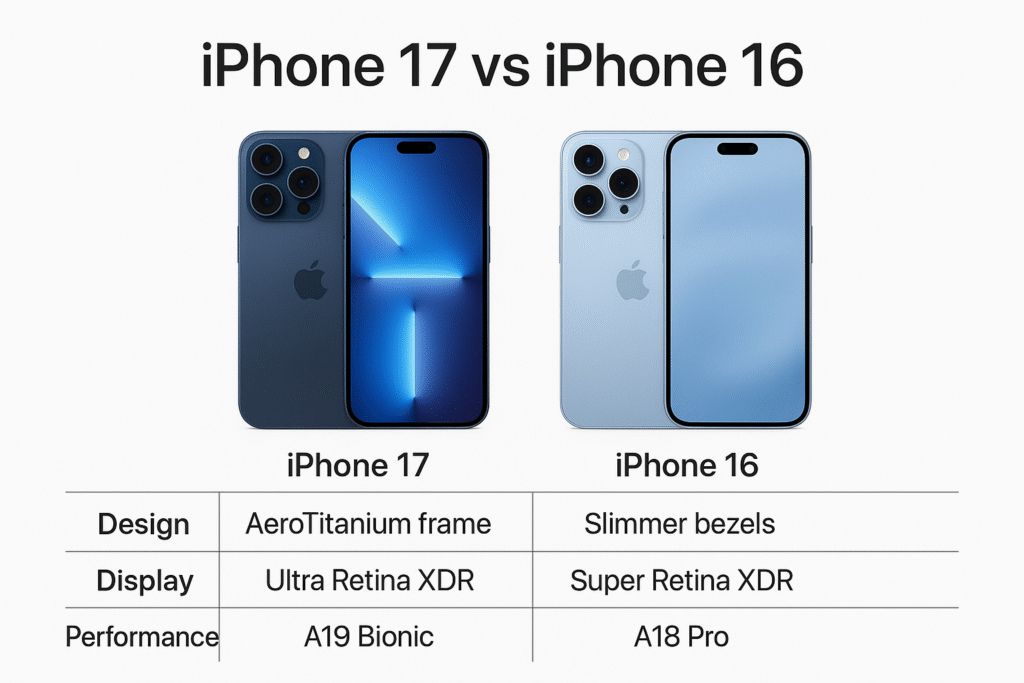
Apple has always been at the center of attention when it comes to smartphone innovation. On Tuesday, September 10, 2025, the company officially revealed the iPhone 17 lineup. This announcement immediately raised comparisons with last year’s iPhone 16 series. Many people are now asking one important question: how different is the iPhone 17 from the iPhone 16?
In this article, we will explore the key features of both models. We will also explain the similarities, differences, and whether the upgrade is truly worth it.
Design and Build
The iPhone 16 series brought a slightly taller design compared to its predecessor. It also introduced slimmer bezels, making the screen look more immersive. Apple kept the flat edges that users have loved since the iPhone 12. The material options included aluminum and titanium for the Pro models, giving a premium finish.
The iPhone 17, however, takes design to a new level. Apple has introduced AeroTitanium, a lighter but stronger frame. This makes the phone feel sturdy while being easier to hold. The bezels are even thinner, almost giving an edge-to-edge display experience. Apple also introduced fresh colors, including Midnight Blue and Soft Gold, alongside the classic options.
Another noticeable change is the size. While the iPhone 16 Pro Max was already large, the iPhone 17 Pro Max is slightly slimmer and lighter despite housing a bigger battery. This balance between size and comfort makes it more appealing to long-time Apple fans.
Display Upgrades
The iPhone 16 models offered Super Retina XDR OLED panels. They supported ProMotion technology with a refresh rate of up to 120Hz for smoother animations. Brightness levels reached 2000 nits outdoors, which was already impressive.
The iPhone 17 steps it up with a new Ultra Retina XDR Display. Apple claims it is the brightest display they have ever built, reaching up to 2400 nits outdoor brightness. This is excellent for people who use their phones in direct sunlight.
Another key difference is power efficiency. The iPhone 17’s display consumes less battery while providing higher brightness. Apple also improved HDR performance, making videos and games look even more realistic.
Performance and Chipset
Performance has always been a strong selling point for Apple. The iPhone 16 Pro models came with the A18 Pro chip, which used a 3nm process. It was powerful, efficient, and handled gaming and multitasking with ease.
The iPhone 17 introduces the new A19 Bionic chip. Built on a second-generation 3nm process, this chip brings faster speeds and better AI performance. According to Apple, the A19 improves machine learning tasks by 30% compared to the A18. This means better photo processing, smoother gaming, and improved voice recognition.
In real-life usage, the iPhone 17 feels faster when switching apps or editing 4K videos. For gamers, the graphics improvements are noticeable. The phone handles demanding titles without frame drops, making it a strong choice for mobile gaming.
Camera System
The iPhone 16 brought solid camera improvements, especially in the Pro models. It introduced a 48MP main sensor and offered better low-light photography. The iPhone 16 Pro Max even included a 5x telephoto zoom lens, but it was limited to the largest model.
With the iPhone 17, Apple made major camera updates across the lineup. Both the iPhone 17 Pro and Pro Max now feature the 5x telephoto zoom, giving users more flexibility in photography. The main sensor has also been upgraded to a 50MP sensor with larger pixels, which captures more light and detail.
Video recording has also improved. The iPhone 17 introduces 8K video recording for the first time, aimed at creators and professionals. Apple’s new Cinematic Vision Mode allows real-time depth adjustments in video, giving a film-like quality.
Selfie lovers will also be happy. The front camera on the iPhone 17 has improved low-light performance and better stabilization for video calls.
Battery Life and Charging
The iPhone 16 series offered decent battery life, with the Pro Max lasting almost a full day of heavy use. Charging options included MagSafe wireless charging and fast charging with a USB-C port.
The iPhone 17 improves on this with a larger battery capacity and more efficient power management. Apple claims that the iPhone 17 Pro Max can last up to 2 extra hours compared to the iPhone 16 Pro Max. This is a welcome upgrade for users who rely heavily on their phones throughout the day.
Charging speeds remain similar, with wired charging at 30W and MagSafe at 15W. However, Apple has introduced Reverse Wireless Charging on the iPhone 17. This means you can charge accessories like AirPods or even another iPhone by placing them on the back of your device.
Software Experience
Both the iPhone 16 and iPhone 17 run on iOS 18, but the iPhone 17 takes more advantage of the new features. iOS 18 introduced Apple Intelligence, the company’s advanced AI system. On the iPhone 17, this system works faster and more smoothly thanks to the A19 chip.
Features like Smart Summaries, AI Photo Editing, and On-Device Translation are more responsive on the iPhone 17. While the iPhone 16 also supports these tools, the performance difference is noticeable.
Storage and Pricing
The iPhone 16 lineup started with 128GB for the base model and went up to 1TB for the Pro Max. Prices started at $799 for the iPhone 16 and $999 for the iPhone 16 Pro.
For the iPhone 17, Apple kept the same storage options but added a new 2TB storage option for professionals who need massive space. Prices for the iPhone 17 start at $849, while the iPhone 17 Pro begins at $1049. The Pro Max with 2TB storage can go above $1,699, making it one of the most expensive iPhones ever.
Should You Upgrade?
The decision to upgrade depends on your current phone. If you own an iPhone 16, the improvements in the iPhone 17 might feel incremental unless you need better cameras, longer battery life, or AI performance. However, if you are using an older model like the iPhone 14 or iPhone 15, upgrading to the iPhone 17 will feel like a big step forward.
Final Thoughts
The iPhone 17 vs iPhone 16 debate shows how Apple continues to refine its devices every year. The iPhone 16 brought strong updates, but the iPhone 17 builds on them with a better design, brighter display, improved cameras, and more efficient performance.
For most users, the iPhone 17 is the ultimate choice if they want the latest and greatest. However, the iPhone 16 remains a solid option at a lower price. Whether you choose to upgrade depends on how much you value the new features Apple has introduced this year.