OpenAI Faces Backlash Over ChatGPT’s Mental Health Monitoring System
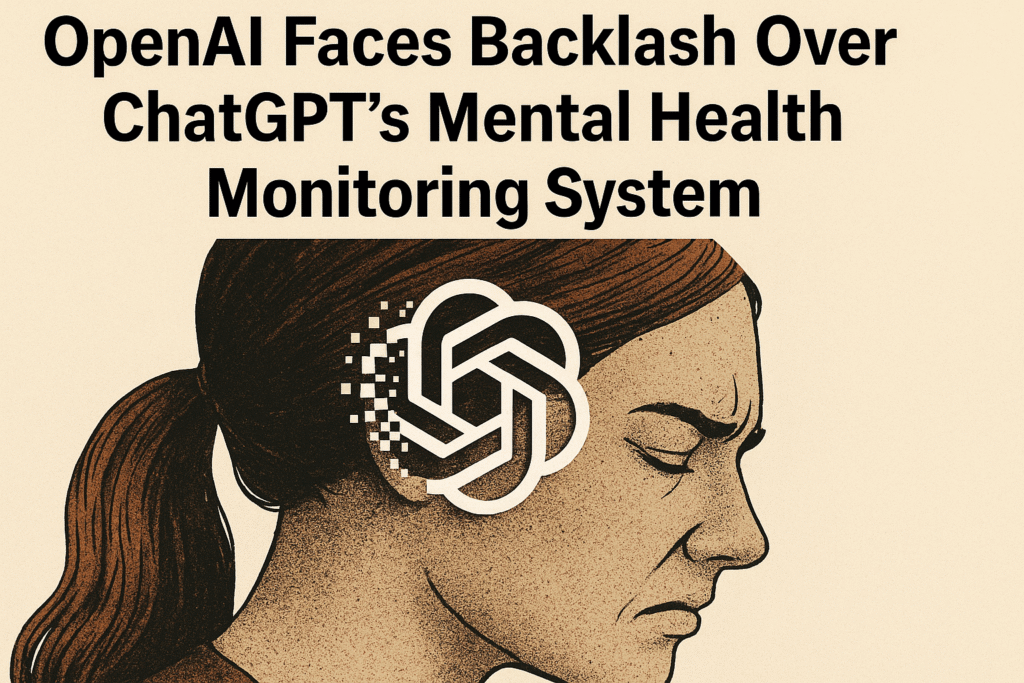
OpenAI has sparked a fresh wave of criticism after revealing how it identifies and handles mental health concerns, suicidal thoughts, and emotional dependence among ChatGPT users. The company shared these details on Monday, explaining that it has created special “taxonomies” — structured guides that help define sensitive conversations and undesired chatbot behavior.
According to OpenAI, these safety systems were developed in collaboration with mental health professionals and clinicians. However, the company’s methods have raised alarm among many users, who accuse OpenAI of overstepping boundaries and attempting to “moral police” how people interact with its AI chatbot.
OpenAI Explains Its Mental Health Safety System
In a recent post, the San Francisco-based AI company said it has trained its large language models (LLMs) to better recognize emotional distress, calm down tense conversations, and encourage users to seek professional help when needed. ChatGPT has also been updated with an extended list of crisis helplines and can now redirect sensitive chats from one model to another that is designed for safer responses.
These improvements are based on the new taxonomies created by OpenAI. The company explained that while the guidelines instruct ChatGPT on how to behave during potential mental health crises, detecting such issues accurately is not simple. OpenAI added that it does not rely solely on general usage data but performs structured testing before introducing new safety features.
When discussing specific mental health issues, the company said that symptoms of psychosis and mania are relatively easier to identify compared to depression, where recognizing severe or acute symptoms is more complex. Detecting suicidal intent or emotional dependency on the AI is even harder, OpenAI admitted. Still, the firm expressed confidence in its system, saying it has been reviewed and validated by clinicians.
Findings and Data Shared by OpenAI
Based on its internal research, OpenAI estimated that about 0.07% of its weekly active users show potential signs of psychosis or mania. Another 0.15% might display suicidal tendencies or signs of emotional dependence on the AI chatbot.
The company said it worked with nearly 300 psychologists and physicians from around 60 countries to design its mental health assessment system. Out of them, 170 experts were reported to have supported OpenAI’s approach in one or more areas of its research.
Growing Public Backlash
Despite the detailed explanation, OpenAI’s announcement has triggered strong reactions online. Many users have criticized the company’s methods, arguing that they are not reliable enough to detect real mental health problems. Others have raised concerns about OpenAI interfering in how adults choose to interact with AI, describing it as an act of “moral policing.”
Critics argue that such monitoring goes against OpenAI’s own promise of “treating adult users like adults.” They believe that the company’s system could misinterpret user behavior and wrongly flag emotionally charged but harmless conversations.
One user on X (formerly Twitter), @masenmakes, said:
“AI-driven ‘psychosis’ and AI reliance are emotionally charged and unfortunately politicised topics that deserve public scrutiny, not hand-selected private cohorts!”
Another user, @voidfreud, pointed out inconsistencies in the reported data:
“The experts disagreed 23–29% of the time on what responses were ‘undesirable.’ That means for roughly 1 in 4 cases, clinicians couldn’t even agree whether a response was harmful or helpful. So who decided? Not the experts. The legal team defines ‘policy compliance.’”
The Broader Debate
The controversy has reignited discussions about the balance between AI safety and user privacy. While many agree that detecting mental health risks is important, others argue that automated systems like ChatGPT are not yet capable of accurately interpreting complex human emotions.
Some mental health advocates say that while OpenAI’s intentions might be good, it is risky to let algorithms determine when someone is in crisis. They warn that incorrect detection or overreach could make users feel monitored or distrusted — possibly discouraging open communication altogether.
Meanwhile, supporters of OpenAI’s initiative say that responsible AI must be proactive in handling sensitive topics. They believe that having built-in safeguards, hotline recommendations, and redirection systems can help prevent harm in extreme situations.
Conclusion
OpenAI’s recent transparency about its mental health safety evaluation has opened an important but divisive conversation. On one side, it shows a growing commitment to user well-being and ethical AI. On the other, it raises valid fears about privacy, judgment, and how much control tech companies should have over human-AI relationships.