


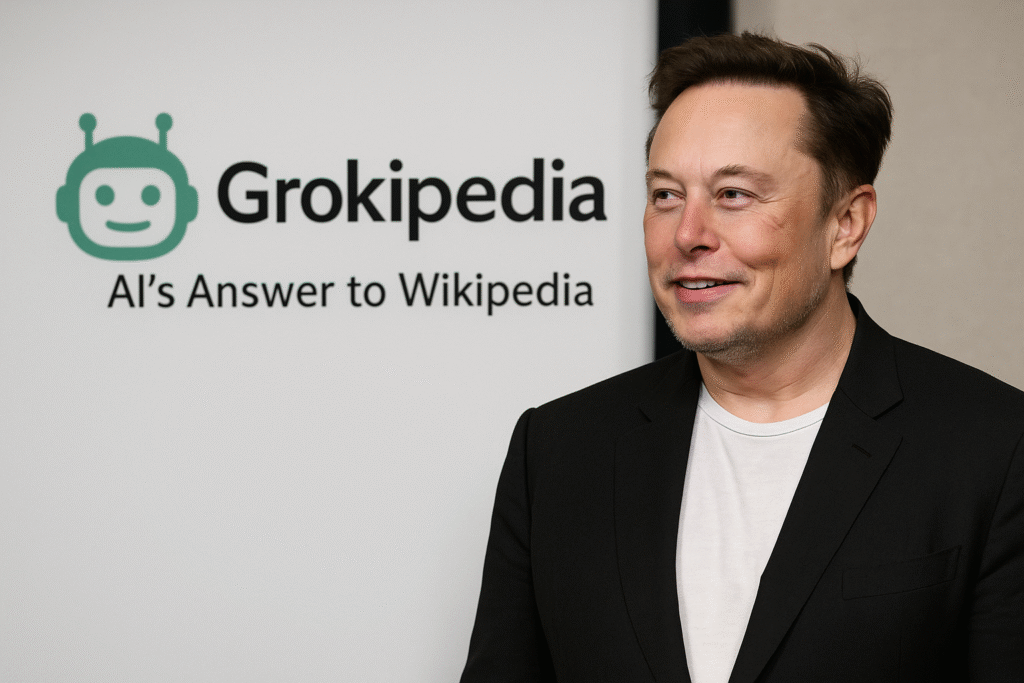
Elon Musk has officially launched a new artificial intelligence-powered online encyclopedia named Grokipedia, which he claims is built to focus on “truth” and eliminate what he calls “bias” found in traditional platforms. The first version of the site, Grokipedia v0.1, went live on Monday, allowing users to browse and search for articles generated and maintained entirely by AI.
Musk has been teasing Grokipedia for several weeks, describing it as a better and more accurate version of Wikipedia. Unlike Wikipedia, which depends on human editors to add and verify information, Grokipedia’s content is completely managed by Grok, the AI chatbot created by Musk’s xAI company. Currently, users cannot manually edit articles or contribute new entries; all updates come directly from Grok’s system.
Musk Calls It Better Than Wikipedia
Announcing the launch on X (formerly Twitter), Musk wrote that Grokipedia’s first version marks the start of a new kind of knowledge platform. “Version 1.0 will be 10X better, but even now at version 0.1, it’s already better than Wikipedia in my opinion,” he said in his post.
In another update, Musk revealed that Grokipedia will be fully open-source and free for everyone to use. This means developers, researchers, and curious readers can explore and utilize the platform without any fees. The move is seen as a direct challenge to Wikipedia, which has long been the most widely used online encyclopedia and a key data source for many apps and AI systems—including Musk’s own Grok chatbot. Musk has also hinted that Grok will soon stop using Wikipedia data entirely and rely on Grokipedia instead.
A Simple, AI-Driven Knowledge Base
Right now, Grokipedia’s website has a minimalistic look. Its homepage only features a large search bar where visitors can enter topics to explore. According to Musk, the platform already hosts around 885,000 articles covering major global subjects, science, history, and technology.
However, the platform operates very differently from traditional wikis. Users cannot edit or fact-check the entries themselves. Instead, they can ask Grok to make changes or improvements if they spot mistakes or missing details. This gives AI full control over what appears on the page.
Early Criticism and Copyright Concerns
Just hours after its release, Grokipedia started attracting criticism and controversy. Technology news outlet The Verge reported that many articles on Grokipedia seem to use Wikipedia content. Some pages appear to have been rewritten by Grok’s AI, while others allegedly contain copied text directly from Wikipedia.
To address this, some Grokipedia pages reportedly include a small note stating, “The content is adapted from Wikipedia.” This has raised questions about copyright, originality, and transparency, especially since Musk’s project claims to be a “truth-based” platform distinct from existing sources.
Lauren Dickinson, a spokesperson for the Wikimedia Foundation, which operates Wikipedia, responded to the situation. She said, “Wikipedia’s strength lies in its transparent policies, community-driven editing, and constant review process. This human knowledge forms the backbone of many AI systems — even Grokipedia relies on Wikipedia to exist.”
What Makes Grokipedia Different?
While Wikipedia is built and maintained by millions of volunteer editors, Grokipedia’s defining feature is AI autonomy. Every article, update, and edit comes from Grok’s language model, which Musk says aims to deliver factual, bias-free information. The lack of human editing, however, also means there’s no peer review or transparent source verification—something critics argue could lead to errors or AI-generated misinformation.
Musk envisions Grokipedia as part of his broader plan to integrate AI more deeply into daily information access. It aligns with his ongoing push to make xAI’s Grok chatbot a more capable and independent tool, free from what he calls “mainstream data filters.”
Looking Ahead
Grokipedia is still in its earliest form, with version 0.1 serving as a testing ground for Musk’s vision of a fully AI-driven knowledge system. The entrepreneur has promised major improvements in the coming months, including more accurate sourcing, cleaner design, and faster updates powered by AI reasoning.
Whether Grokipedia will truly rival Wikipedia remains to be seen. Wikipedia continues to dominate the online information world with its massive community of editors and rigorous citation requirements. Musk’s AI version, while innovative, will need to prove that it can provide trustworthy information without the guidance of human experts.
For now, Grokipedia represents Elon Musk’s latest attempt to redefine how people find and trust information online—and his boldest challenge yet to the world’s most well-known encyclopedia.